
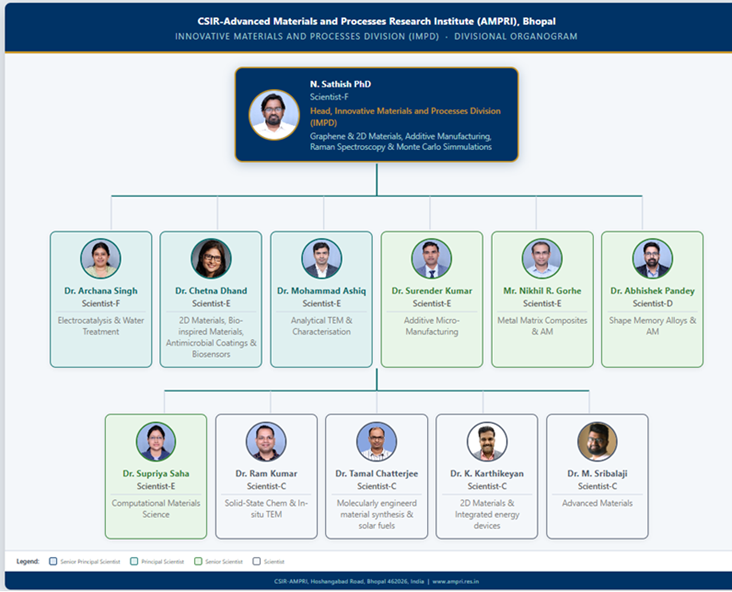
The Innovative Materials and Processes Division (IMPD) at CSIR-AMPRI, Bhopal, is a leading national research division working at the frontier of advanced materials science and next-generation manufacturing. IMPD encompasses twelve permanent scientists with expertise spanning additive manufacturing, graphene and 2D materials, electrochemistry, computational materials science, molecular catalysis, and biomedical sensing. The division operates cutting-edge metal additive manufacturing facilities — including Laser Powder Bed Fusion (LPBF) and Electron Beam Melting (EBM) alongside graphene synthesis, characterization, and standardization infrastructure. IMPD is nationally recognized for demonstrating, for the first time internationally, graphene-reinforced SS316L composites via LPBF with 67% higher yield strength than bare stainless steel. The division has developed India’s first commercial Make-in-India Raman Spectrometer and is actively pursuing CEMILAC certification of indigenized aerospace-grade AM components in collaboration with ADA and HAL. Funded by multiple national agencies, IMPD is aligned with strategic national missions including Make in India, Waste to Wealth, the National Quantum Mission, and the National Green Hydrogen Mission. With over 450 cumulative SCI publications and extensive international collaborations, IMPD serves as a critical hub for translating fundamental materials research into national industrial and defence applications.
| Research Area: |
- Metal Additive Manufacturing
-
- Laser Powder Bed Fusion (LPBF) and Electron Beam Melting (EBM) PBF of metals and composites
- Graphene-reinforced SS316L, Ti64, Aluminium, and Nickel superalloy composites
- Qualification and CEMILAC/DGQA certification of indigenised AM powders for aerospace and defence
- In-situ alloying via pre-mixed powders in LPBF; Oxide Dispersion Strengthened (ODS) alloys
- Wire Arc EBM DED; Hybrid AM processes
- Graphene, 2D Materials & Nanocomposites
-
- Large-area graphene growth via RTP-CVD on copper foils; transfer to flexible substrates
- Graphene oxide, reduced graphene oxide, MXenes, hBN, siloxene, and metalene synthesis
- Graphene-metal and graphene-polymer composite manufacturing via AM and conventional routes
- Standardisation of graphene and 2D materials (aligned with ISO/IEC/BIS)
- Raman Spectroscopy & Instrumentation
-
- Design and development of India’s first commercial Make-in-India Micro Raman Spectrometer (NMITLI programme)
- Multimode Raman system for medical/clinical diagnostics (cancer, infectious disease)
- Photo-Luminescence (PL) spectroscopy and optical emission spectroscopy integration
- Electrocatalysis & Energy Materials
-
- Electrocatalysts for alkaline hydrogen evolution reaction (HER) and oxygen evolution reaction (OER)
- CO2 reduction to value-added fuels and chemicals; artificial photosynthesis
- Self-charging power cells: integration of nanogenerators with supercapacitors
- High-performance supercapacitors for electric vehicles (EVs); metal-air batteries; direct methanol fuel cells
- Electrochemical transistors using 2D nanosheets
- Sustainable Materials & Circular Economy
-
- Recovery of rare earth elements (REE) and critical metals from e-waste via SWE, adsorption-desorption, and molten-salt electrolysis
- Plastic waste valorisation using electrochemical, piezoelectric, and heterogeneous catalysis
- Water treatment: removal of PFAS, microplastics, arsenic, fluoride using engineered materials
- SmFeN permanent magnet synthesis via additive manufacturing (CSIR-REFORMS/ROSATOM/Sumitomo collaboration)
- Computational Materials Science
-
- DFT and DFTB-based electronic structure exploration of nanomaterials and quantum materials.
- Advanced materials modeling for Sustainable and renewable energy conversion, Spintronics applications and Topological materials.
- Quantum optimization algorithms and quantum simulations for materials science
- Photocatalytic CO2 reduction; molecular sensing
- Carbon nanotube nucleation and growth dynamics via quantum chemical simulations
- Biomedical & Sensing Materials
-
- Nanofibrous materials, hydrogels, and bio-inspired coatings for biosensors and wound care
- Biosensors for neurological disorders and infectious disease diagnostics
- Antimicrobial coatings for urinary catheters; wearable sensors
- Biomaterials for tissue engineering; 2D materials-based heavy metal detection
- Shape Memory Alloys & High-Temperature Materials
-
- Cu-Al-Mn, Cu-Al-Ni shape memory alloys; effect of quaternary additions
- High-strength, high-conductivity metal matrix composites and copper-graphene composites
- High-temperature deformation studies; ODS ferritic steels
| Goals / Objectives: |
- Develop and transfer technologies in advanced and innovative materials for national industrial, defence, aerospace, and healthcare sectors.
- Establish internationally benchmarked Additive Manufacturing capabilities for metal, polymer, and composite systems and pursue CEMILAC and DGQA certification for aerospace and defence components.
- Advance graphene, 2D materials, and nanocomposite research from synthesis to device-level demonstration, with a focus on standardization aligned with ISO/BIS/IEC frameworks.
- Design and develop next-generation energy solutions: supercapacitors, electrocatalysts for hydrogen evolution, CO2 reduction, and critical mineral recovery from waste streams.
- Translate computational materials science and molecular catalysis insights into functional devices for solar fuels, chemical sensing, and biomedical diagnostics.
- Foster national and international collaborations to build a national facility for integrated additive manufacturing and attract multi-agency funding from CSIR, DST, ANRF, and industry.
- Train the next generation of researchers through AcSIR, PhD supervision, and sponsored project fellowships.
| Notable Achievements: |
Landmark Scientific Outcomes
- First-ever international demonstration of Graphene + SS316L composite via LPBF: 850 MPa yield strength and 35% elongation (67% improvement over bare SS316L), with 20–30% higher thermal conductivity and 40% higher electrical conductivity.
- Demonstrated high-temperature deformation of Graphene-SS316L up to 900°C (vs. 500°C for plain SS316L) and superior corrosion resistance.
- Development of India’s first commercial Make-in-India Raman Spectrometer under the NMITLI programme (₹201 lakhs).
- Designed and fabricated India’s first indigenous Wafer-Scale Graphene Standardisation facility using RTP-CVD.
- Published first application of molten salts synthesis to discover a polar mixed-anion 3D framework (Zn4Si2O7Cl2) for photoelectrocatalysis (Angewandte Chemie, IF = 16.6).
- Demonstrated supramolecular layered heterostructures via non-covalent synthesis (Chemistry of Materials, IF = 8.6).
- Top 2% scientists in the world (Stanford’s global list): Dr. Archana Singh and Dr. K. Karthikeyan.
- Centre of Excellence in Graphene and its Applications (FCP) — ₹1,480 lakhs, CSIR (PI: Dr. N. Sathish).
- Graphene-reinforced metal matrix composites for aerospace and defence (CSIR FTT/AEISS) — ₹798 lakhs.
- Large-area graphene via RTP-CVD (CSIR Mission) — ₹195 lakhs.
- NMITLI Raman Spectrometer — ₹201 lakhs.
- PM Early Career Research Award (ANRF) — Dr. Ram Kumar.
- Cumulative external funding from CSIR, DST, ANRF, ICMR, SERB, IGSTC, and industry.
- PM Early Career Research Award (ANRF) — Dr. Ram Kumar (2024/25).
- Best Employee Award 2025, CSIR-AMPRI — Dr. Ram Kumar.
- IGSTC WISER Award 2024 — Dr. Archana Singh.
- Merck Young Scientist Runner-Up Award 2023 — Dr. Archana Singh.
- Humboldt Postdoctoral Fellowship (RWTH Aachen) — Dr. Archana Singh.
- Best Foreign Faculty Research Achievement Award (2019 & 2021) — Dr. K. Karthikeyan, Jeju National University.
- Young Faculty Research Excellence Award — Deputy Prime Minister, South Korea — Dr. K. Karthikeyan.
- Ramanujan Fellowship (SERB) — Dr. Ram Kumar.
- ‘MAKE OUR PLANET GREAT AGAIN’ Postdoctoral Grant from French President — Dr. Tamal Chatterjee (2018).
- Beatriu de Pinos Grant (AGAUR), Spain — Dr. Tamal Chatterjee (2023).
- Best Poster Award, CANDEE-2025 (IIITM Gwalior) — Student under Dr. Archana Singh.
- MMI 2025 Notable Paper Award — IMPD team (KIM).
- Notable Book Chapter Award and CSIR Research Fellowship — Student under Dr. Chetna Dhand.
- Cumulative SCI Publications: ~450+ (division-wide across all scientists).
- H-index highlights: Dr. K. Karthikeyan (H = 63; 15,912 citations), Dr. Chetna Dhand (H = 41; 6,300 citations), Dr. Ram Kumar (H = 28; 4,695 citations), Dr. N. Sathish (H = 19).
- International Patents: Dr. Archana Singh — 3 (USA); Dr. K. Karthikeyan — 1 (WIPO).
- Indian Patents: Multiple filed/granted across division.
- Know-how transferred: 5 (Dr. Archana Singh).
- Invited lectures delivered: >15 (Dr. N. Sathish), >10 (Dr. Chetna Dhand).
- PhD students trained: 3 completed (graphene AM programme); multiple ongoing.
| Collaborations: |
- OSATOM Additive Technologies, Russia — Joint development of graphene-metal composites for nuclear and aerospace additive manufacturing.
- Sumitomo Metal Mining Co. Ltd., Japan — SmFeN anisotropic bonded magnets via additive manufacturing.
- Monash University, Australia — Electrocatalysis, water treatment, and sustainable fuel production (Dr. Archana Singh, Dr. Abhishek Pandey).
- University of California, Berkeley / Lawrence Berkeley National Lab, USA — Advanced in-situ TEM techniques (Dr. Ram Kumar).
- Collège de France / CNRS Paris, France — Molten salt synthesis of novel inorganic frameworks (Dr. Ram Kumar).
- RWTH Aachen, Germany — Alexander von Humboldt Fellowship programme (Dr. Archana Singh).
- ICIQ, Spain & University of Paris, France — Molecular catalysis and CO2 reduction (Dr. Tamal Chatterjee).
- Jeju National University, South Korea — 2D materials and energy storage (Dr. K. Karthikeyan).
- National Chiao Tung University, Taiwan & Nagoya University, Japan — Computational materials (Dr. Supriya Saha).
- Defence — Aeronautical Development Agency (ADA), HAL (AERD): Qualification of Ti64 Grade 5 powders for Laser and EBM PBF; CEMILAC certification of aerospace components.
- Industry — EATON, TACC, Indo Borax, Water Engineers India: Sponsored R&D and technology development.
- LOHUM Cleantech: Recovery of cobalt and critical metals from used lithium-ion batteries.
- GEETAM University: Collaborative research proposal under CSIR-EMR.
- UGC-DAE: Hybrid alkaline electrolyzer and self-powered H2 production systems.
| Facilities:: |
- Laser Powder Bed Fusion (LPBF) — 3D Systems DMP Flex 350 (Ti, SS, Al alloys and composites)
- Electron Beam Melting (EBM) — Arcam A2X (Ti64, Ni superalloys, high-temperature materials)
- Bio-Printer — multi-material biological scaffold printing
- Composite Printer — fiber-reinforced polymer composites
- Functional Printing system — printed electronics and functional coatings
- E-TRANSCAP — electrochemical additive manufacturing / ECAM system
- RTP-CVD Reactor for large-area graphene growth on Cu foils
- Wafer-Scale CD-SEM Standardisation Facility for graphene and 2D materials
- Chemical synthesis labs for graphene oxide, MXene, hBN preparation
- Analytical HR-TEM — advanced electron microscopy, in-situ TEM, electropolishing, sample prep (Dr. M. Ashiq lab)
- Raman Spectrometers (including Make-in-India prototype)
- FTIR Spectrometers
- UV-Visible Spectrophotometers
- Gas Chromatography (GC)
- Electrochemical Workstations (cyclic voltammetry, EIS, galvanostat)
- Vacuum Induction Melting Furnace
- Tube, Muffle, and Hot Air Ovens
- Glove Box
- Optical Microscope, Metallography cutting & polishing
- High-performance computing (HPC) workstations for DFT, DFTB, quantum simulations (CSIR-4PI Servers)
- Dedicated computational materials science lab (Dr. Supriya Saha group)